“So, this is where God put the West.”
John Wayne
With these few words, dedicated to Monument Valley, John Wayne also describes what Utah represents to the whole world: the promised land of Western movies.
It was undoubtedly thanks to John Ford, who fell in love with its red sandstone cliffs, isolated wind-carved spires, and endless expanses stretching to the horizon, that he decided to shoot his most successful films here, thereby cementing the West in the collective imagination.
However, to think that Utah is only about the Old West and national parks is a mistake that risks overlooking incredible landscapes and marvelous film locations from other genres. Utah offers a landscape with a deep and complex history, capable of transforming—just a few dozen kilometers away—into unexplored alien planets, the halls of power in Washington, the corridors of beloved teen musicals, and so much more.
Before the cameras arrived, Utah was the setting for a real-life epic just as grand: in 1847, Mormon pioneers led by Brigham Young crossed the mountains in search of a place where they could freely practice their faith, far from persecution. Looking out over the Salt Lake Valley, Young uttered the historic phrase “This is the place”, founding what today, it is the State of “Deseret” (the worker bee, a symbol of diligence). The Mormon influence has shaped the architecture, culture, and layout of Utah’s cities, creating a fascinating contrast between the rigidity of its historic institutions and the absolute, untamed freedom of its natural parks.
While working in the field on the Through the Lens project in collaboration with Visit Utah, Discover Moab, Base Camp Kanab and Bryce Canyon Country, I researched, created, and traveled along an extraordinary itinerary to discover the historical and natural wonders of this beautiful State through film locations and the Utah Film Trail.
What is the Utah Film Trail?
As you plan a trip to Utah and search for information, you may come across the slogan “Utah. America’s Film Set.®”.
This is a registered trademark, a motto proudly adopted by the Utah Film Commission, that captures a profound truth: for the film industry, the entire state is a vast open-air film set.
In Hollywood’s early days, studios were accustomed to recreating their worlds on backlots (the areas behind California’s soundstages), but the majesty of nature could not be replicated in those small spaces. Utah offered a gigantic, ready-made set, with a geological diversity capable of transforming into any world the filmmakers desired. The first to recognize this potential were Chauncey, Gronway, and Whitney Parry, two enterprising brothers from Kanab. In 1924, they tucked a photo album of their spectacular canyons under their arms and traveled to Hollywood in person to convince producers to step outside their studios. It was a brilliant move, and that year they brought director Lynn Reynolds and the entire crew from Fox Film Corporation to Utah to shoot the silent film The Deadwood Coach, the first film ever shot in Utah. It was only the beginning of a relationship that, as James V. D’Arc – a film historian and former curator of the Motion Picture Archive at Brigham Young University – masterfully documents in his essay “When Hollywood Came to Utah”, would attract over a thousand productions to the state.
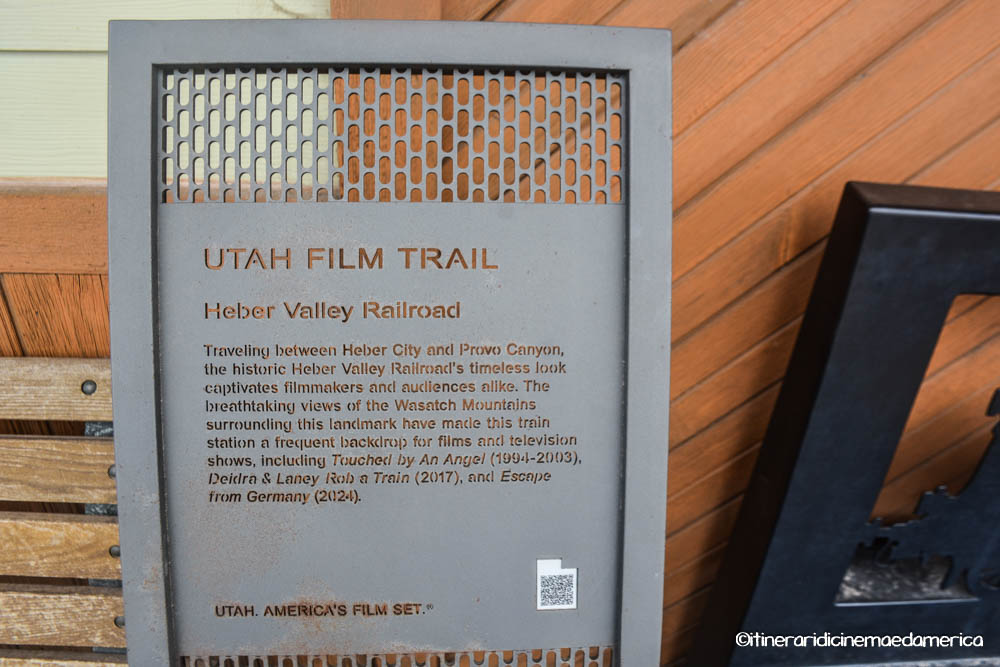
To honor this long and rich relationship, in 2024 the Utah Film Commission officially celebrated 100 years of film and television productions by launching the Utah Film Trail, an extensive network of themed routes covering the entire state. The trail is marked by dozens of commemorative plaques – the “Film Trail Markers” – installed at the exact locations where the film scenes were shot.
While speaking with representatives from the Utah Film Commission and the Moab to Monument Valley Film Commission (the oldest film commission in the world!) for my research, it became clear just how hard these institutions work to keep the legacy of these locations alive, transforming exploration of the region into a true journey of cinematic discoveries and stories.
Here is the complete itinerary, stop by stop, to discover the beauty of Utah through the lens of cinema (I’ll go into more detail about each stop in separate articles, because every place deserves much more than just a paragraph).
St. George
Founded in 1861 by Mormon pioneers sent by Brigham Young to grow cotton – which is why the area is still nicknamed Utah’s “Dixie” – St. George is the perfect geological crossroads where the Mojave Desert meets the Colorado Plateau. The climate is milder than in the rest of the state, and the landscape is dominated by majestic cliffs of volcanic rock that glow with warm colors at sunset.
This contrast is also reflected in its cinematic spirit: on the one hand, Snow Canyon State Park, which, with its petrified dunes and black lava rock, served as the backdrop for Paul Newman and Robert Redford’s desperate rides to escape the posse – in Old West slang, a group of armed citizens temporarily assembled and authorized by the sheriff to hunt down outlaws – in Butch Cassidy (1969); on the other, the lush green golf courses of the Entrada Country Club, better known as “Lava Springs Country Club,” the setting for the summer dance sequences in High School Musical 2. And here’s a little behind-the-scenes tidbit: to film in the middle of the desert during the summer, the cast found themselves dancing in temperatures exceeding 45 degrees Celsius (113 Fahrenheit)! Disney had to set up huge air-conditioned tents on the lawn to keep the dancers from fainting during filming!
In addition to the sets, the historic district is well worth a thorough visit to see the Brigham Young Winter Home, where you can learn about the pioneers’ hardships; look up to see the St. George Temple, a snow-white building that stands out against the red rock; head up to Pioneer Park for an unparalleled panoramic view of the entire valley… here, don’t miss the white “DIXIE” inscription on Dixie Rock!
To wrap things up, take a stroll along Main Street, a lively area featuring a mix of modern and historic buildings.
Grafton
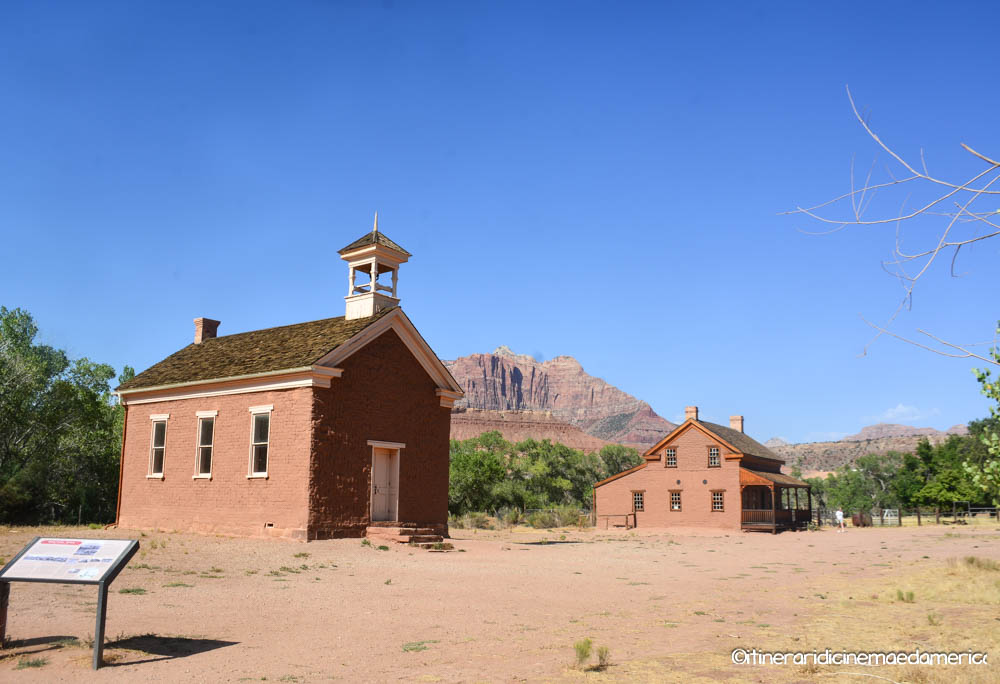
Tucked away south of the majestic Zion National Park and bordered by the Virgin River, Grafton is the most famous and most-photographed ghost town in the American West. Founded in 1859 by Mormon families, its history was brief and troubled: constant flooding and isolation drove the residents to abandon it permanently in the early 20th century, leaving it intact and frozen in time.
The surreal silence of this place has been broken several times by film crews shooting scenes for various movies, but one in particular stands out as the most memorable: the romantic scene in which Paul Newman rides a bike carefree with Katharine Ross in Butch Cassidy, accompanied by the strains of “Raindrops Keep Fallin’ on My Head” (which Redford felt was unsuitable for the film’s genre, but he had to change his mind when they won the Oscar for Best Original Score).
Being the perfectionist that he was, Newman insisted on shooting the scene without stunt doubles, carrying the actress on the handlebars himself. He managed to do so almost entirely: the production team forced him to step aside and use a stuntman only for the very last shot, the one in which the bicycle crashes backward through a wooden fence.
Grafton’s cinematic significance, however, does not end there, because even though it is just a ghost town, it holds a fundamental record in film history: it was the first true on-location set for sound cinema. In 1929, for the first time, the film crew left the studios to shoot on location and came to Grafton, where “In Old Arizona” – the first talkie filmed outside a studio, nominated for five Oscars – came to life.
To truly explore one of America’s most fascinating ghost towns, be sure to visit the old schoolhouse from 1886, the restored little church, and the only house still standing – where you’ll find the hat—which you can try on – that belonged to the real Butch Cassidy. Before leaving, it’s worth stopping at the small pioneer cemetery, where the graves of Grafton’s residents and the Native Americans who lived in the area still remain.
Since it’s just a stone’s throw from Springdale, Grafton is the ideal detour to combine with an exploration of Zion National Park.
Cedar City
Known throughout the state as “Festival City USA,” Cedar City is a lively and elegant small town, nestled halfway between the red deserts of the south and the cool alpine forests of the north, just a stone’s throw from the spectacular natural amphitheater of Cedar Breaks National Monument. Its famous nickname stems from the dense network of cultural events that enliven its streets, the undisputed highlight of which is the Utah Shakespeare Festival. Founded in 1961 as a small summer college festival, this event has grown exponentially, becoming, in every sense, a colossal, permanent, and professional theater company. Its caliber is so high that it has earned it a Tony Award (the theater equivalent of an Oscar) for Best Regional Theater in America. During the summer and fall months, the entire town is transformed: the squares around the university fill with actors in lavish period costumes, musicians, outdoor performances, and a vibrant atmosphere that turns Cedar City into a veritable open-air stage.
Off the beaten path for movie lovers and fans of film locations, Cedar City holds significant historical importance: it was right here, in 1924, that the vision of brothers Chauncey, Gronway, and Whitney Parry came to life. Before moving south to open the Parry Lodge in Kanab, the brothers ran a transportation business in this area. When they convinced Hollywood to film The Deadwood Coach in Utah, the crew and heavy equipment arrived by freight train right at the Cedar City rail terminal. The Parry brothers stepped in as drivers and porters, using the town as their very first base camp to transport star Tom Mix to the canyons (this story about the Parry brothers is incredible—it deserves a proper in-depth look, and I’ll tell you all about it!). Since then, the surrounding mountains and railroads have continued to serve as the backdrop for great classics, from the epic Union Pacific (1939) to Drums Along the Mohawk (1939).
While you’re here, in addition to enjoying the packed schedule of theater events or the exhibitions at the Southern Utah Museum of Art, take half a day to drive along the picturesque Scenic Byway 14. It will take you up to an altitude of nearly 3,000 meters at Cedar Breaks National Monument: an amphitheater of pink and orange limestone structurally similar to Bryce Canyon, but much less crowded, significantly cooler, and surrounded by lush, flower-filled high-altitude meadows.
Payson
Driving north for about 310 km, the landscape changes dramatically, and Utah reveals its greener, more rural side. Nestled at the foot of the imposing Wasatch Mountains, Payson is the very epitome of small-town America. Founded in 1850 by Mormon pioneers, this little town looks like something out of a Norman Rockwell painting or a John Hughes film. Wide, quiet streets; meticulously manicured lawns bordered by white picket fences; wooden porches; and a very strong sense of community. Here, the reassuring and nostalgic aesthetic of 1980s America reigns, watched over from above by the imposing silhouette of Mount Nebo, the region’s highest peak.
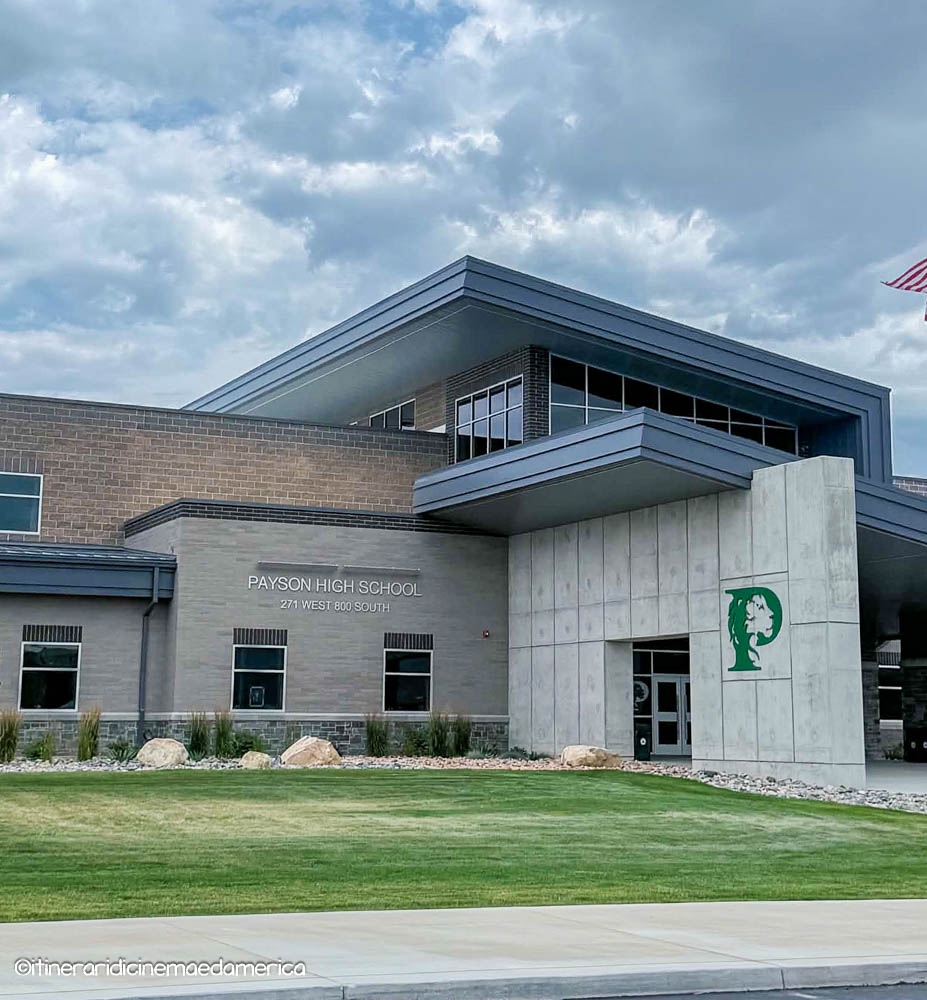
Precisely because of its conservative and quintessentially “Middle America” atmosphere, the production team of Footloose chose Payson in 1984 to serve as the fictional town of Bomont. For decades, the quintessential cult classic location was Payson High School, whose hallways, lockers, and athletic fields served as the backdrop for Ren McCormack’s dance-fueled rebellion. Today, the original building no longer exists; it was demolished in June 2025 to make way for a more modern, renovated campus, as the old one was falling apart. Just before it was razed, however, the students organized a special event—coinciding with the film’s 40th anniversary—by launching the #BaconToPayson initiative to bring Kevin Bacon back to the school one last time, raising funds for his charity, SixDegrees.org. At the last minute, the school administration decided to save Ren McCormack’s iconic original locker, reinstalling it right in the hallways of the new building.
Despite the absence of the iconic school, the magic and traces of the film are still alive, and all the other locations that hosted the filming are still incredibly recognizable.
After stopping by the high school and some iconic landmarks, the best thing to do is visit downtown for a glimpse into local history. The most charming building is the Peteetneet Museum and Cultural Arts Center. Housed in a magnificent Victorian-style elementary school built in 1901 and named after a Ute Native American chief, it’s a red-brick gem that now features exhibits on pioneer life and collections of period clothing.
But Payson’s true masterpiece is its natural beauty: the town serves as the northern gateway to the Mount Nebo Scenic Byway, a winding scenic route that climbs through the Uinta National Forest. If you pass through here between September and October, this detour offers spectacular fall foliage: the aspen groves blaze with a dazzling gold, creating an unforgettable color contrast against the Utah sky.
Provo (e Lehi)
Nestled between the placid waters of Utah Lake and the majestic, jagged peaks of the Wasatch Range dominated by the unmistakable silhouette of Mount Timpanogos, Provo is the dynamic heart of Utah County. Home to the prestigious and imposing Brigham Young University (BYU), the city combines the youthful, vibrant energy of a college town with a well-ordered urban layout, rooted in a deep heritage of pioneering, agricultural, and industrial traditions. It is a place of transition, both geographic and visual, between the rural American South and the greater Salt Lake City metropolitan area.
Next to Provo – a city that has served as the filming location for several Hallmark Christmas movies – lies Lehi, the setting for other key scenes in Footloose.
Along its main street, the historic Lehi Roller Mills has stood since 1906; inside, we saw Kevin Bacon let loose in his character Ren McCormack’s solo dance, trying to shake off his frustration with acrobatic moves and music.
The decision to film inside an actual mill was director Herbert Ross’s idea, but it turned out to be a nightmare for the crew due to the extremely fine flour dust suspended in the air. The visual effect was magnificent, perfectly capturing the beams of light from the spotlights… There was, however, a major problem: flour dust, when concentrated and overheated in an enclosed space, is explosive. The crew had to work on constant alert, halting filming at regular intervals to cool the lights and prevent a single spark from blowing up the entire facility. But the effort was worth it, because that sequence has become immortal!
Back in Provo, a recommended stop is the BYU Museum of Paleontology, a true research laboratory that manages and analyzes fossils excavated right here in southern Utah, making it one of North America’s leading academic centers for the study of dinosaurs.
Leaving town and heading northeast, the road enters Provo Canyon almost immediately, a deep gorge carved by the river of the same name. Following this road, a short drive of just a few minutes takes you to the base of Bridal Veil Falls, spectacular two-tiered waterfalls that plunge nearly two hundred meters down a rocky vertical cliff face. The trail from the parking lot is paved, short, and accessible to everyone.
Salt Lake City
Continuing north, you’ll reach Salt Lake City, the capital city nestled in a valley embraced by the Wasatch Mountains. Founded by Mormon pioneers fleeing persecution, it’s a city of two faces: on one hand, there’s the austere rigor of its religious history, which dictates the rules of urban planning; on the other, a youthful energy pulses through the city, fueled by independent microbreweries and a genuine passion for the outdoors. It’s the perfect base camp for exploring the northern part of the state.
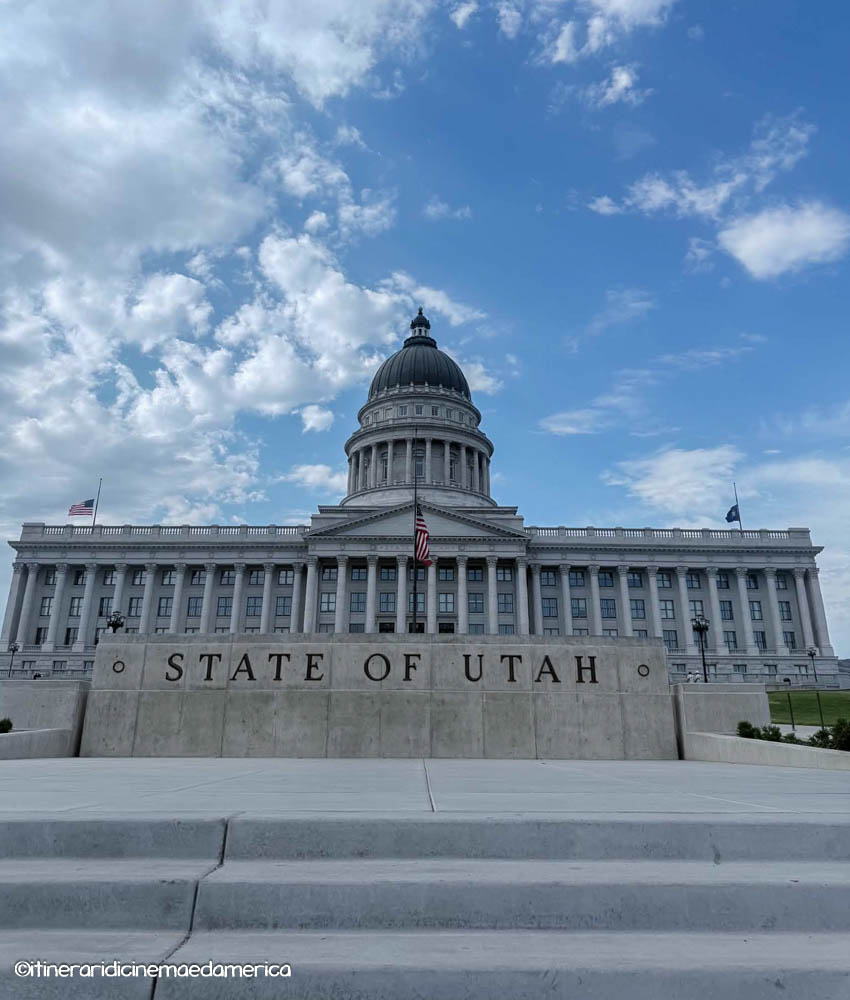
And it is precisely this versatility that has made it a prized location for Hollywood location managers. If a director needs to shoot a film in Washington, D.C., for example, but doesn’t want to deal with the long and difficult bureaucratic process of obtaining permits, they know they can choose the Utah State Capitol, a majestic granite and marble building perched on the hill overlooking downtown. It is a neoclassical masterpiece so similar to the U.S. Capitol’s Legislative Building that it is often used as its “stand-in.” It was on its very steps that Reese Witherspoon, dressed in her bright pink suits, marched in Legally Blonde 2.
Also, as you head down toward the city center, you can see the large intersections where Jim Carrey and Jeff Daniels drove their unforgettable fur-covered van in Dumb & Dumber.
And then there’s the place that for twenty years (a milestone celebrated this very year!) has drawn thousands of fans from all over the world: East High School, the heart of the High School Musical phenomenon. For the production, Disney chose to film at a real public high school, and the crew found themselves working within time slots calculated down to the minute so as not to interfere with the school bell and regular classes. Even today, when you enter the school, you’ll find the iconic red lockers from the movie, the iconic cafeteria, the theater where Troy and Gabriella auditioned, and all the other locations from the film, all clearly recognizable.
Once you’ve discovered the film’s shooting locations, the starting point for exploring the rest of the city is Temple Square, the monumental Mormon Temple that marks the “kilometer zero” from which the city’s entire street layout radiates.
Don’t miss This Is The Place Heritage Park, it’s a true journey back in time where you can experience a day in the life of the pioneers, exploring authentic period buildings while strolling among friendly actors in costume, going about their daily activities just as they did back then (the barber, the blacksmith, the schoolteacher…).
Salt Lake City is also the ideal starting point for a trip to one of the most fascinating landscapes on the planet: the Bonneville Salt Flats. By relying on the expertise of Southwest Adventure Tours, you can reach this boundless expanse of white salt in complete safety and comfort, a true visual mirage that has starred in numerous films. It is here that Will Smith drags the unconscious alien in Independence Day (1996), and it is this ghostly white crust that took the form of “Davy Jones’ Locker” in Pirates of the Caribbean: At World’s End (2007), where Johnny Depp plays multiple versions of Jack Sparrow aboard the Black Pearl. Not to mention that this salt mirror is the home of the speed records chronicled in The World’s Fastest Indian (2005), starring Anthony Hopkins.
Deer Valley e Park City
Less than an hour’s drive from Salt Lake City, as you climb in elevation, the atmosphere changes once again, and you reach Park City, entering the alpine heart of Utah. This charming former 19th-century mining town has been transformed into a luxury resort, while nearby Deer Valley is one of America’s most exclusive ski resorts, famous (and, for some, infamous) for its absolute ban on snowboarding on the slopes.
We’re at the headquarters of the Sundance Film Festival, the true home of independent cinema, amid luxury chalets and pristine slopes famous throughout the world. These mountains provided the snow-covered scenery for Dumb & Dumber, in which Park City is passed off as Aspen. Remember the famous scene where Jeff Daniels’ character kisses the icy chairlift pole and gets his tongue stuck to it? It was filmed in this area. But don’t worry, the set designers built a fake fiberglass pole with a tube inside that pumped hot air, allowing the actor to safely press his tongue against it and pull it away!
However, many people (especially fans of Christmas movies like me!) will probably recognize the locations from Falling for Christmas, the Netflix romantic comedy that marked Lindsay Lohan’s long-awaited return to the screen. The stunning wood-and-stone lodges featured in the film, where the spoiled protagonist discovers the meaning of life after a skiing accident, are actually ultra-luxurious properties in Deer Valley, specifically the Stein Eriksen Lodge and the iconic Goldener Hirsch.
Despite its reputation as a ski resort, however, Park City’s Main Street is a gem in perfect Victorian style. As you stroll among the colorful historic buildings, many of which house art galleries and upscale restaurants, don’t miss the High West Distillery, the world’s only “ski-in/ski-out” distillery (meaning you can arrive on skis, take them off right outside the door, and order a whiskey to warm up).
Sundance Mountain Resort
As the road begins to descend southward, it winds its way through a wild gorge before suddenly opening up at the foot of Mount Timpanogos’s massive rock face, where the Sundance Mountain Resort is located.
Purchased in 1969 by a very young Robert Redford, it is a mountain retreat founded with the aim of balancing human presence and the wilderness, protecting this valley from aggressive development. The atmosphere is intimate and rustic, with dark-wood lodges perfectly camouflaged among forests of centuries-old pine trees, waterfalls, and streams.
A few years later, the rugged, unspoiled mountains surrounding the resort proved to be exactly what Redford and director Sydney Pollack needed to shoot an unconventional Western: Jeremiah Johnson (1972). The film tells the story of a man weary of civilization who decides to flee to the Rocky Mountains (much as Redford did in real life years later, when he transformed Sundance into a refuge for artists who needed to devote themselves to their work far from the chaos of movie studios) to live as a hermit, learning to survive on his own. To capture that sense of absolute isolation, the production team decided to shoot almost entirely on location, in the middle of winter, right in the woods around Sundance.
During filming, weather conditions were terrible, with snowstorms and sub-zero temperatures, turning the shoot into a real struggle for survival. At one point, the entire production crew was stranded for days in a cabin, with food and electricity in short supply. They had to wait for the arrival of large government snowplows to clear a path through the snow and restore access. The experience helped Redford recreate that same physical exertion and those hardships in the character he was playing, which are evident on Redford’s face in every shot.
Today, Sundance is a community dedicated to the arts, perfectly reflecting its founder’s vision. Even if you don’t ski, I recommend taking the scenic chairlifts to admire the Mount Timpanogos massif up close: it’s one of Utah’s most impressive natural spectacles. Take some time to visit the Art Studio, a workshop open to the public where visitors can learn pottery and jewelry-making.
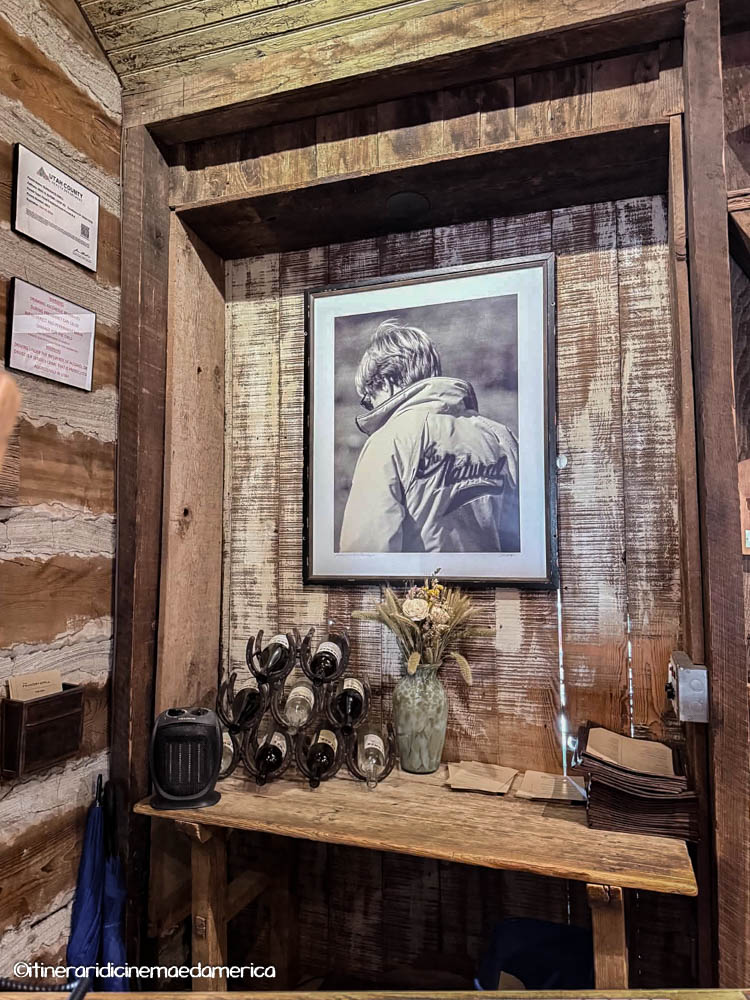
Finally, to end your visit on a high note, book a table at The Tree Room: the resort’s award-winning restaurant, built around a living tree and adorned with a private collection of Native American art and film memorabilia personally donated by Robert Redford.
Aside from winter, the best time to visit is undoubtedly fall, when you can admire Utah’s most beautiful fall foliage while driving along the Alpine Loop Scenic Byway, a winding scenic road that also runs through the resort, climbing through dense forests until it nearly reaches Mount Timpanogos.
A word of advice: drive at a snail’s pace, because the road is extremely narrow and has no center line. In winter, snow completely buries it, closing it to traffic.
Green River e la Goblin Valley
Continuing south for about 250 km, the horizon opens up dramatically, and the green of the mountains gives way to the red and ochre hues of the earth.
The next stop is Green River, the classic, tiny farming oasis split in two by the highway, famous throughout the state for its fields of sweet melons. It’s the very essence of the American road trip, the perfect place to stop for gas, stretch your legs, and breathe in the warm desert wind.
To take full advantage of the vastness and isolation of this landscape, Marvel chose to film one of the most spectacular action sequences from the movie Thunderbolts here. Driving east on Old Highway 6 and Highway 50, you’ll find the very same road where Bucky Barnes (Sebastian Stan) races on his motorcycle to save Yelena Belova (Florence Pugh) and the rest of the team during their escape into the desert. The Utah Film Trail marker, however, is located outside the J.W. Powell River History Museum, a museum opened in 1990 and dedicated to John Wesley Powell, a one-armed geologist and explorer – he lost his other arm during the Civil War who led several exploratory expeditions along the Colorado River (you can see the 1960 Disney film Ten Who Dared, starring John Beal, about this expedition).
Less than an hour’s drive from Green River lies Goblin Valley State Park, an incredible geological labyrinth where millions of years of erosion have carved thousands of mushroom-shaped sandstone pinnacles, aptly named “goblins”. There are no trails to follow: the adventure lies in walking freely and getting lost among these whimsical and mysterious rock formations, which you can even climb (with the utmost respect for them).
Such a unique, almost alien landscape was a ready-made film set. In fact, in 1999, the sci-fi comedy Galaxy Quest was filmed right in the midst of these bizarre rock formations to recreate the surface of an extraterrestrial planet.
The experience was a bit of an ordeal for the crew: in the height of summer, the rocky valley reflects the sun, turning into a veritable oven, and the actors – from Tim Allen to Sigourney Weaver and Alan Rickman – forced to perform while wrapped in heavy rubber space suits, were constantly monitored by the crew’s doctors to prevent heatstroke.
Moab, l’Arches National Park e dintorni
Continuing eastward, you arrive in Moab, the undisputed world capital of outdoor adventure. Nestled in a vast desert valley along the banks of the Colorado River, it is also and above all a key part of Hollywood history: it’s home to the “Moab to Monument Valley Film Commission,” the world’s oldest film commission, founded in 1949 to attract major film productions to the southern part of the state.
John Wayne himself, “the Duke”, lived here and loved this place, often staying, sometimes for months at a time, to shoot his films, to the point that he’s now considered a local. He always stayed at the Apache Motel, a historic and still proudly vintage establishment, with a suite dedicated to him: the very same room where John Wayne himself slept!
Moab is also the perfect starting point for exploring Arches National Park, the dizzying cliffs of Dead Horse Point, and Canyonlands National Park, three of the most spectacular places in the United States.
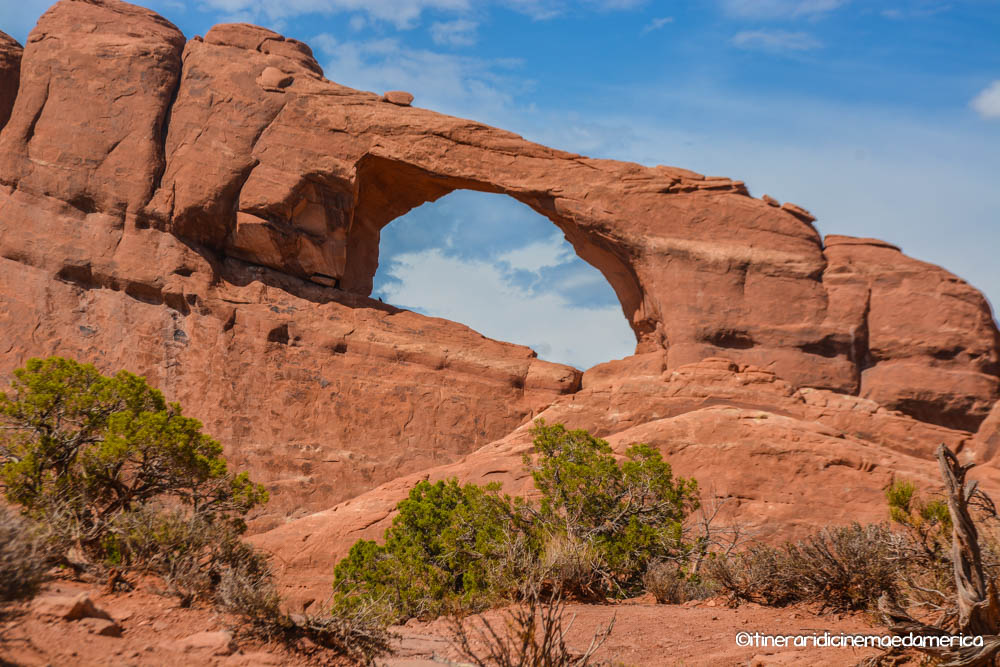
Entering Arches is like walking into an open-air museum that is home to over two thousand natural red-rock arches, whose shapes seem to defy gravity. The most interesting spot for movie buffs is Double Arch, the location where a very young River Phoenix gallops by on horseback in the very first minutes of Indiana Jones and the Last Crusade.
Nearby Dead Horse Point State Park, on the other hand, offers a magnificent view of the meandering Colorado River, hundreds of meters below. It was from these cliffs overlooking the abyss that Ridley Scott filmed the final plunge of the Ford Thunderbird in Thelma & Louise, even though in the film it’s passed off as the Grand Canyon, and where a fearless Tom Cruise filmed the free-climbing scene that opens Mission: Impossible II. Cruise insisted on actually filming at a height of 600 meters – secured by thin cables that were later removed in post-production – literally terrifying director John Woo, who refused to look at the monitors for fear of seeing him fall into the canyon.
A little spoiler: On March, 2, 2027 Godzilla x Kong: Supernova will hit theaters: a film featuring several scenes shot right on Main Street in Moab!
Monument Valley
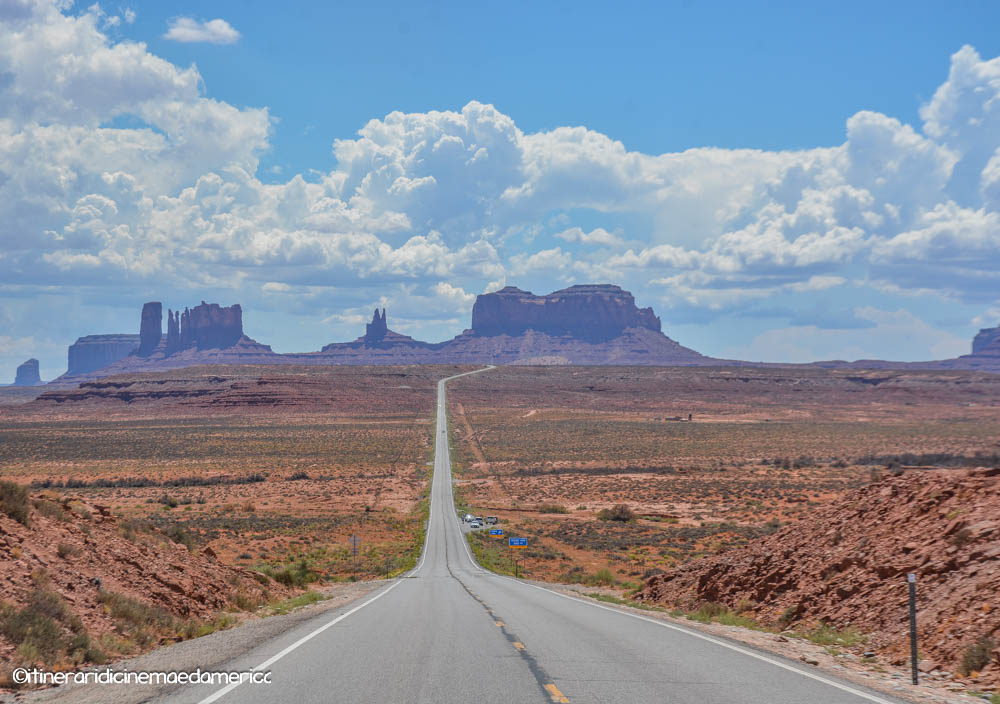
Crossing into the Navajo Nation and seeing the gigantic monoliths of Monument Valley silhouetted against the horizon is a powerful visual and emotional experience. Because, believe me, no photo or video can prepare you for the vastness that unfolds before your eyes as you drive along those roads.
We’re in the cathedral of Western cinema, in one of the most famous places in the world, and yet that “I’ve seen this before” feeling, as can happen with New York, is nowhere to be found here. Its beauty and grandeur, seen in person, take your breath away.
The reason we all recognize the silhouettes of the Mitten Buttes or Merrick Butte at first glance today is due to the persistence of Harry Goulding, an ordinary man who, in 1938, while facing the Great Depression alongside the Navajo families of the region, decided to go for broke: he took the last sixty dollars he had left, tucked a photo album under his arm, and drove his carriage all the way to Los Angeles. Once he arrived at the United Artists studios, he threatened to pitch a tent in the hallway until someone would see him. The photos ended up on John Ford’s desk; he was blown away by them, and within a few days, he moved the entire crew to the desert to shoot Stagecoach (1939). It was a move that changed their lives: the production brought jobs, wages, and resources to the community, sparking a deep and unbreakable bond with the film industry.
From that moment on, John Ford returned to the valley to shoot no fewer than seven masterpieces, including the immortal The Searchers (1956) and My Darling Clementine (1946). The Navajo welcomed him into their community, affectionately naming him Natani Nez, “the Tall Chief,” because of his stature and his authority on set. It’s no coincidence that one of the most evocative spots along Valley Drive is John Ford Point, recognizable at a glance. Standing before this rocky promontory offers one of the most authentic thrills for us film and location enthusiasts.
But the roads of Monument Valley and its boundless horizons have spanned eras and every kind of film genre. It was here that Dennis Hopper and Peter Fonda rode their choppers in the iconic scene from Easy Rider (1969), and it was also here that Marty McFly found himself driving the DeLorean in 1885 in Back to the Future Part III (1990), amid Native American attacks and boundless prairies.
And then there’s the spot that every traveler carries in their heart: driving north on U.S. Highway 163, when you reach mile 13, your eyes and heart are drawn to a straight stretch of asphalt pointing toward the red mountains: this is Forrest Gump Point, the exact spot where Tom Hanks, after three years, two months, fourteen days, and sixteen hours of nonstop running across the United States, suddenly decides to stop right in the middle of the road, turns to his entourage of loyal followers, and utters the phrase that symbolizes an entire generation: “I’m a little tired, I think I’ll go home now.”
Kanab
Leaving the Navajo territories behind and driving northwest toward Zion, you’ll reach Kanab. This welcoming and strategically located town is known worldwide by the unmistakable nickname “Little Hollywood.”
Remember the Parry brothers, the ones we ran into in Cedar City as they were unloading trains for Utah’s very first film shoot in 1924? Well, Chauncey, Gronway, and Whitney were the first to realize that the film industry would move to these marvelous lands, and in 1931 they opened the Parry Lodge right here in Kanab, a beautiful Victorian-style building designed specifically to host Hollywood stars during their desert shoots. It was a brilliant idea that was an instant success. Everyone has stayed within these walls: from John Wayne to Clint Eastwood, including Maureen O’Hara, the entire Rat Pack with Frank Sinatra, Dean Martin, and Sammy Davis Jr, who came to town in 1962 to film Sergeants 3, and many others.
Even today, the Parry Lodge is open and in full swing: as you stroll under the motel’s arcades, you can read the names of celebrities on the room doors, and if you step into the dining room, you’ll find yourself surrounded by hundreds of autographed vintage photographs taken right here.
But in Kanab, you can still feel the magic of cinema in every corner: in addition to its very own Walk of Fame (plaques dedicated to actors who’ve stayed here, scattered throughout the city), downtown you’ll find the “Little Hollywood Museum”, a fascinating free attraction that houses original old movie sets abandoned in the desert after filming.
There are countless locations where movies were filmed or that are connected to the film industry, especially in the surrounding area, and we were able to explore them with the legendary and incredibly knowledgeable cowboy John Jacobs, a true expert and film enthusiast. I’ll tell you all about it in a detailed post!
A little gem away from the sets: if you’re an animal lover, you can arrange a visit from here to the nearby Best Friends Animal Sanctuary, the largest and most famous animal sanctuary in the United States. Or, to explore the lesser-known natural wonders in the area, the ideal choice is to hop aboard Dreamland Safari Tours‘ 4×4 off-road vehicles for a combined excursion to Peekaboo Slot Canyon (also known as Red Canyon) – a narrow, winding crevice of orange rock sculpted by sunlight, far from the crowds of the more famous parks – and the Dinosaur Tracks, a rocky plain where real, still-clear dinosaur footprints dating back over two hundred million years are imprinted.
Bryce Canyon National Park
For the grand finale of our road trip through Utah, we head north. We also climb in elevation, reaching 2,400 meters, where the air suddenly turns crisp and dense pine forests hide the red rocks until the very last moment.
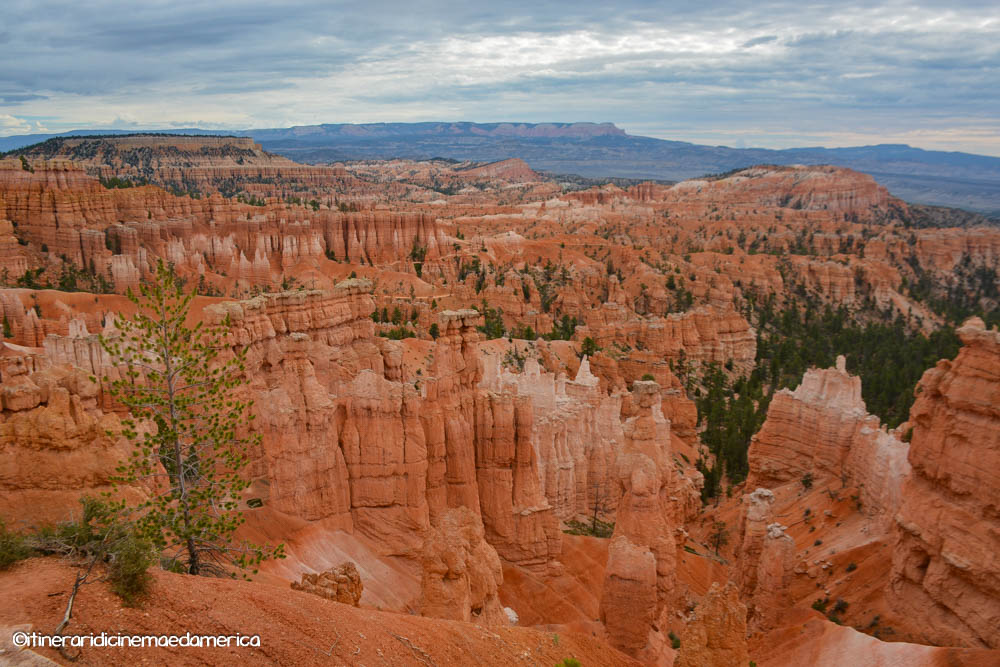
We conclude this circular itinerary in the spectacular Bryce Canyon, a gigantic natural amphitheater shaped like a horseshoe, filled with thousands of limestone spires called hoodoos (the “fairy chimneys”).
Looking out over Bryce Canyon for the first time is literally breathtaking: it is not a true canyon, but a complex of gigantic, horseshoe-shaped natural amphitheaters, filled with thousands of limestone pinnacles called hoodoos (the “fairy chimneys”). A geological labyrinth that ranges from bright orange to pink to pure white – depending on the age of the rocks – and appears to have been sculpted by an artist’s hand.
Here we return to the origins of the state’s connection to the film industry: as we’ve already mentioned, it was here in 1924 that the Parry brothers brought their cameras to shoot the silent film The Deadwood Coach. In subsequent years, the park’s pinnacles continued to attract film crews: rides among the fairy chimneys served as the backdrop for adventure Westerns such as Thunderhead – Son of Flicka (1945) and for some spectacular shots in the epic How the West Was Won (1962); the touching road movie Bonneville (2006), starring Jessica Lange, Kathy Bates, and Joan Allen, in which the three protagonists drive across Utah in a vintage convertible, stopping to gaze at the dizzying amphitheater, one of the film’s most moving scenes; in Bedazzled (2000), the diabolical Elizabeth Hurley chooses these red backdrops to put the naive Brendan Fraser to the test.
Once you’re here, though, don’t limit yourself to viewing the amphitheater only from the overlooks. The best way to experience Bryce is to venture down into it: the Navajo Loop Trail, for example, lets you walk right at the base of the hoodoos; or you can explore unique trails on a beautiful horseback ride.
For an unforgettable farewell to Utah, set your alarm before dawn and head to Sunrise Point. Watching the first rays of the sun set the pink rocks ablaze as the night’s chill fades is a perfect, almost moving spectacle that no cinematic special effect can match.