
Boston returns to the small screen: the Reagan family’s stories move from the streets of New York to the historic alleys of Massachusetts. Danny changes cities but remains tied to his pillars: the law, family, and conscience.
Let’s start with the series that started it all: Blue Bloods.
Produced by CBS and created by Robin Green and Mitchell Burgess, it aired from 2010 to 2024. It stood out in the American crime scene for its unique structure: a police drama that combined the procedural format (series in which each case is introduced and solved within the same episode) with family storytelling. So not only investigations and cases to solve, but also bonds, values, and conflicts within the Regan family, whose members are all, in different ways, part of the New York City Police Department.
At the center of the series is Tom Selleck (the legendary star of Magnum P.I.) as Frank Reagan, the respected police commissioner who leads both the city and his family with firmness and a sense of honor. Alongside him are his children, Danny (Donnie Wahlberg), Erin (Bridget Moynahan), and Jamie (Will Estes), each engaged in their own battle for justice, as well as his father, Henry (Len Cariou), a retired former commissioner. Completing the family saga is the shadow of the eldest son, Joe, who died in the line of duty but is always present in the Reagans’ memories.

Now let’s focus on Danny, Frank’s eldest son.
Raised in Bay Ridge, Brooklyn, alongside his siblings, he has always breathed the air of justice and duty. After high school, he held various jobs before enlisting in the Marines, where he fought in Iraq and was decorated for his bravery. Returning to New York, he joined the NYPD, where he has served since 1995. An old-school detective, he is impulsive and tenacious, often torn between following the rules and his conscience. He was married for over twenty years to Linda O’Shea, a nurse, with whom he had two sons, Jack and Sean. Their home in Staten Island was destroyed in an attack by a drug cartel, and shortly afterwards, Linda lost her life in a mysterious helicopter accident, probably due to another act of revenge. Despite his grief, Danny continued to serve the city, first with his partner Jackie Curatola and then with Maria Baez, earning the respect of his colleagues and numerous honors for his courage.
Impulsive but intensely loyal, Danny embodies the Reagan tradition: family first and justice as a vocation. He is a man who bears the scars of his past but never stops believing in the law and the possibility of doing what is right.
After 14 seasons, Blue Bloods has closed its doors, opening the way for the spin-off Boston Blue (incidentally, Boston is Donnie Wahlberg’s hometown), produced by CBS Studios and Jerry Bruckheimer Television.
In this new chapter, Danny Reagan leaves Manhattan to move to Boston, where he joins the local police force and teams up with Lena Silver, played by Sonequa Martin-Green. Like Danny, she also comes from a family with a long tradition in law enforcement. For Wahlberg, the idea of bringing Danny back in a different setting came about as a story of “a fish out of water”: a man from New York grappling with a new city and a different way of understanding justice. When CBS proposed setting the series in Boston, the actor immediately accepted, because the opportunity to explore the rivalry between Boston and New York seemed perfect for breathing new life into the character.
Sonequa Martin-Green, already a star of The Walking Dead and Star Trek: Discovery, found something rare in the project: “A family story about faith, tradition, and dialogue between different worlds.” The bond between Danny and Lena stems from mutual respect and shared experience: two police officers who come from different backgrounds but speak the same language. This is not a pair destined for conflict, but a partnership built on trust and understanding that grows episode after episode.
The heart of the series remains the same as what made Blue Bloods a success: the ability to portray family, the law, and differences with honesty and respect. In Boston Blue, the confrontation moves to new ground: two cities, two identities, two ways of being American, but with the same desire to find common ground. As Wahlberg said, “We may not agree on everything, but we can still love each other”.
Boston Blue locations: itinerary in downtown Boston
Disclaimer: all interior scenes were shot in Toronto, Canada, for budgetary reasons (it costs much less to shoot in Canada than in the US). However, Wahlberg insisted with the production company – of which he is a part, as well as one of the stars – that at least the outdoor scenes be shot in Boston, since, he said, “you can’t replicate the look of Boston” … and I totally agree with him, Boston is unique! It’s no coincidence that it was chosen as the location for some of the best films in cinema history.
The itinerary for discovering the locations of Boston Blue is simple and can be completed on foot in about an hour, without stopping. However, let’s be realistic and consider half a day or a whole day, depending on whether you stop visiting the various tourist attractions, which I highly recommend.
We start from Downtown Boston, the commercial and institutional heart of the city, where many of the most visited attractions are concentrated. Boston has grown up around this area, which for centuries has been the center of city life. Bordered by iconic neighborhoods such as Back Bay, North End, and Beacon Hill, this area is home to historic buildings, modern skyscrapers, lofts, and renovated condominiums, all coexisting harmoniously, a sign of continuous urban transformation.
It is here that you can feel the soul and character of the city that saw the birth of the American Revolution, which rose from the ashes of the Great Fire of 1872 and reinvented itself several times without ever losing its identity.
Today, the city center is a mosaic balancing history and modernity: boutiques, theaters, and cafés surround iconic landmarks such as the Freedom Trail, a 4-km route that passes through the main historical sites of the Revolution, and Faneuil Hall Marketplace, the beating heart of colonial trade, which is still a meeting place for street artists and travelers today.
Not far away, the Rose Kennedy Greenway is a vibrant green ribbon of gardens, art facilities, and public spaces that connect different neighborhoods.
A bit further south, the theaters of the Theater District, such as the sumptuous Boston Opera House and the historic Wilbur Theatre, keep the cultural tradition alive by offering shows, musicals, and concerts every evening.
For book lovers, the Brattle Book Shop is a must-see: among wooden shelves and outdoor stalls, it has been home to rare and out-of-print volumes since 1825. The tour ends at Quincy Market, a 19th-century granite building converted into a lively covered market. Here, the aromas of lobster and clam chowder mingle with the sounds of street musicians, while the stalls and craft shops offer a taste of authentic America.
Of course, in a city as rich in culture as Boston, museums are a must: the Museum of Fine Arts, with one of the most important art collections in the country, and the refined Isabella Stewart Gardner Museum, which houses Venetian treasures and the atmosphere of bygone times in a building that is itself a work of art.
For more information, refer to the dedicated itinerary for Boston.
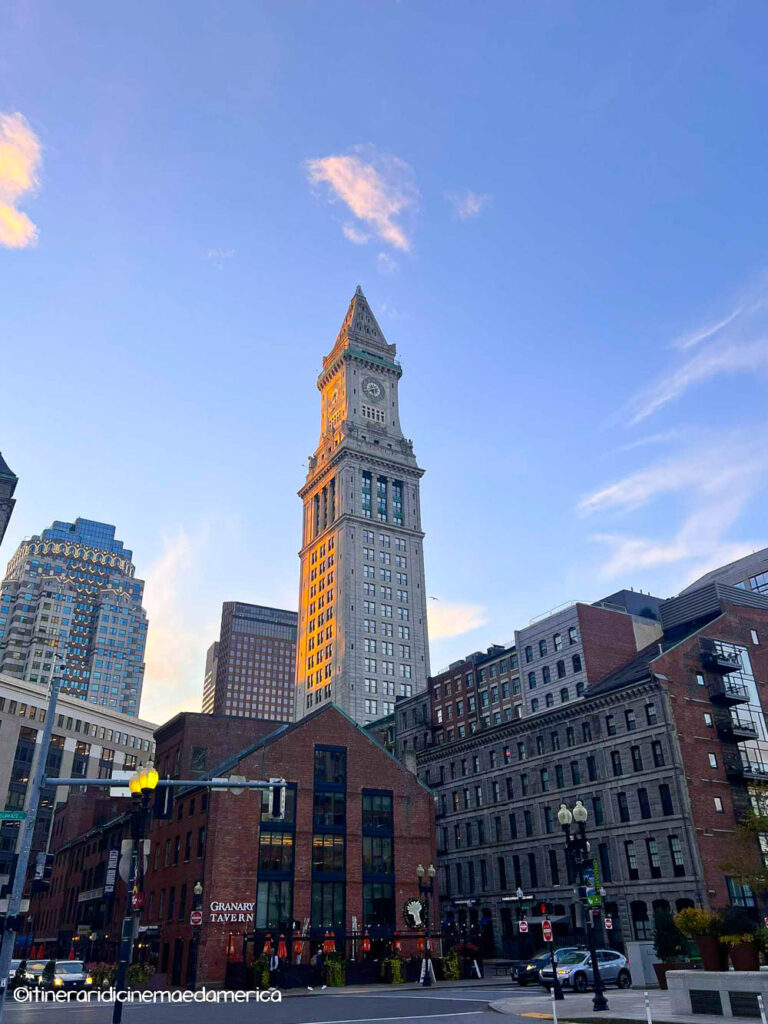
The second location in the series is one of the oldest and most symbolic places in Boston: the Granary Burying Ground, the city’s third public cemetery, founded in 1660. Some of the most famous figures in American history are buried here: Paul Revere, the five victims of the Boston Massacre, and three of the signatories of the Declaration of Independence: Samuel Adams, John Hancock, and Robert Treat Paine.
Today, its 2,300 gravestones (although it is estimated that over 5,000 people are buried here) tell a story that dates back to the early decades of the Puritan colony. The cemetery was established when the nearby King’s Chapel Burying Ground became too small to accommodate the growing population’s burials. Initially called South Burying Ground, it later took the name of the large grain warehouse that stood where Park Street Church is located today. The Egyptian-style entrance, with its wrought-iron gate, was designed in 1840 by architect Isaiah Rogers, who also designed the twin gate at Touro Cemetery in Newport.
One of the most fascinating aspects of this cemetery is its little-known artistic side: the Puritans, who rejected religious images, transformed gravestones into true spiritual symbols. Among the most common motifs is the so-called Soul Effigy, a winged head representing the soul flying towards heaven. Other marble stones are decorated with hourglasses, scythes, and poetic verses that reflect the settlers’ direct and austere relationship with death.
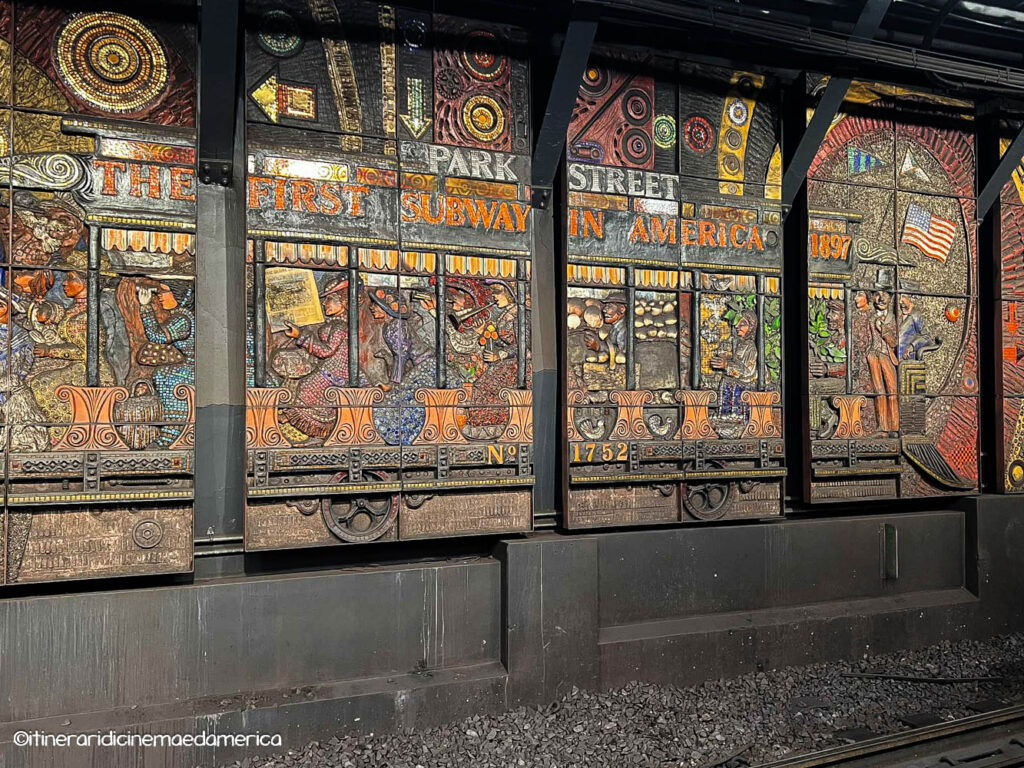
Just a couple of minutes’ walk from Granary Burying Ground is Park Street Station, the third stop on the Boston Blue locations tour.
Opened in 1897 along with Boylston Street Station, these were the first subway stations in the United States, symbols of the modernity that was beginning to take hold in late 19th-century Boston. At the time, the electric cars of the Green Line descended underground right here, sparking an urban revolution that would inspire dozens of other American cities. Today, Park Street remains a key hub of the MBTA system, and with its low ceilings, white-tiled corridors, and vintage signage, it still tells the story of Boston as it once was.
To reach the last, fascinating stop on this itinerary, take the Green Line subway from Park Street, travel five stops to Kenmore, and once you get off, a few minutes’ walk will take you to the legendary Fenway Park, home of the Red Sox (and be sure to come here prepared with your Red Sox flag!) and one of the most beloved shrines of American sport (and the location of several films, including Fever Pitch, starring Drew Barrymore and Jimmy Fallon, and the beautiful Field of Dreams, starring Kevin Kostner).
Opened in 1912, it is the oldest Major League Baseball stadium still in use, but also the second smallest, with a capacity of “only” 37,000.
Affectionately known as The Cathedral, its most famous feature is the Green Monster, the giant green wall in left field, just 94 meters from home plate. Over 11 meters high, it was built of wood and covered over time with various materials, until it was painted the unmistakable green that has distinguished it since 1947. Today, the signatures of the greats who made history can be seen on its interior walls: from Babe Ruth to Ted Williams, from Tris Speaker to Carl Yastrzemski. And while technology advances, its scoreboard is still updated by hand.
Further along, on the right-hand side, is Williamsburg, the bullpen area built in 1940 to give the legendary Ted Williams an advantage: left-handed and powerful, he could thus hit more easily towards the nearest stands, just seven meters less than the original wall. And thanks to him, a single red chair stands out in the stands, in seat 21 of row 37, section 42. It is the Lone Red Seat, marking the spot where, on June 9, 1946, the longest home run ever hit in this stadium fell: a 153-meter shot by Ted Williams himself.
Finally, along the foul line of the right field, Pesky’s Pole shines, the yellow pole that fans consider a lucky charm. It is only 92 meters from home plate, the shortest distance in the entire Major League. It owes its name to Johnny Pesky, after radio commentator Mel Parnell christened it live on air in 1948, giving that simple pole the dignity of a symbol.
Extra: The View Boston
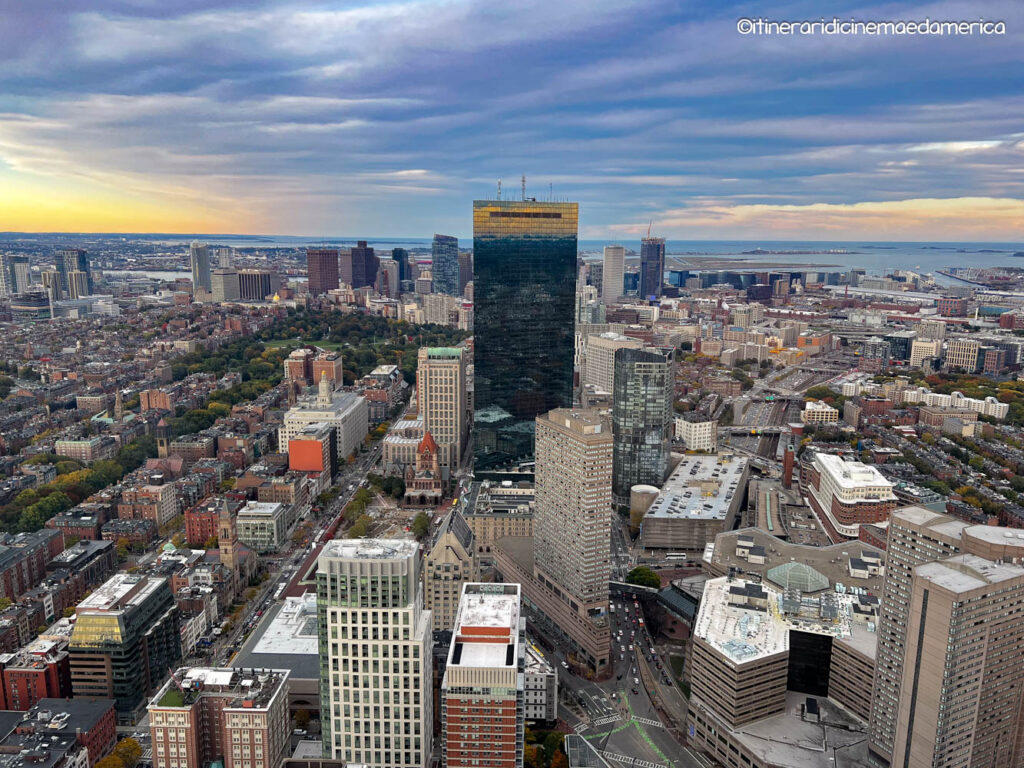
Although it is not one of the official locations (but I doubt it will not appear on screen, because I hope the series will give us many views of Boston), to mark the debut of Danny’s new adventures, The View Boston has created a special cocktail called Boston Blue-Berry, inspired by the series and available only in their rooftop bar, Stratus.
In addition, on the evening of October 17, the Prudential Tower will be lit up in blue in honor of the Boston Police Foundation, a non-profit organization created to help the men and women of the Boston Police Department by offering them not only technological and professional support, but also programs to protect their physical and mental health.
Here is the video from The View, in which Danny Reagan himself presents the news.
Located at the top of the Prudential Center, The View is the place where you can admire a 360° view of the city from two panoramic terraces, one indoors and the other, the Cloud Terrace, outdoors, from a height of over 200 meters. But it’s not just spectacular views: interactive installations, illuminated maps, videos, and stories showcase Boston’s history and spirit.
For me, it’s one of the things not to be missed when visiting the capital of Massachusetts.
More than just a backdrop, Boston Blue captures the city’s raw beauty, reminding us why Boston serves as the perfect mirror for the protagonist’s journey.






Great narrative! Superb descriptive of movie locations. Thank you!
A fascinating tour of Boston Blue filming locations, perfect for fans who love exploring iconic movie and TV spots!