“I am Providence, and Providence is myself – together, indissolubly as one, we stand thro’ the ages; a fixt monument set aeternally in the shadow of Durfee’s ice-clad peak!”
Howard Phillips Lovecraft
With these words, written in a letter to his friend James F. Morton on May 16, 1926, the Master declared his visceral love for his hometown, Providence, capital of Rhode Island, the smallest state in the USA.
Providence, with its ascents and descents, centuries-old cemeteries, college gardens hidden behind gates, dark wooden colonial houses, and the Athenaeum, is easy to mistake for the foggy Arkham if, like us, you love Lovecraft’s tales and worlds. With every step you take in this city, modernity’s sounds and images fade away, and you find yourself slipping into the dark and mysterious atmospheres that forged Lovecraftian imagination in the roaring Twenties.
It is here that, for the literary aficionados of Cthulhu’s world, the veil between reality and the unknown seems to grow thinner, revealing a glimpse of Great Old Ones’s shadows.
And us, huge fans of the Recluse of Providence, could not help but come here to discover his city, creating the ultimate Lovecraft Providence walking tour to explore the real places where he lived, imagined, and created his literary world that over time has given life to films, games, short stories, novels, and comics; shaping the entire universe of the Mythos, deeply rooted in today’s pop culture (and in the nerd culture to which I proudly brag to belong).
Who was H.P. Lovecraft?
On August 20, 1890, Howard Phillips Lovecraft, son of Winfield Scott Lovecraft and Sarah Susan Lovecraft (née Phillips), was born in Providence, at 454 Angell Street, in a house that has unfortunately been torn down. Born into a wealthy family of English descent, H.P. soon saw his world shatter: he was only three years old when his father, suffering a psychotic breakdown, was confined to the Butler Hospital in Providence, where he would die five years later from complications of late-stage syphilis.
Acting as a lifeline in a family dominated by mourning and the overprotectiveness of an emotionally fragile mother was his maternal grandfather, Whipple Van Buren Phillips, the true center of Lovecraft’s childhood universe. He encouraged his prodigious intelligence, opening to him the doors of the vast family library, and also guiding him towards Greco-Roman classics, astronomy, and Gothic literature. It was precisely his grandfather who, to entertain his grandson, began to tell original stories populated by “winged horrors” and “deep, low, moaning sounds”, effectively sowing the very first seeds of what would one day become the Cthulhu Mythos.
In 1896, the death of his grandmother plunged the household into a deep depression. His aunts and mother began wearing black mourning dresses that terrified young Howard, and it was in this oppressive climate, at only five years old, that he began to be tormented by recurring nightmares dominated by monstrous creatures, faceless demons that grabbed him and dragged him at breakneck speed through space: The “night-gaunts” were born, creatures that thirty years later would infest the pages of his stories.
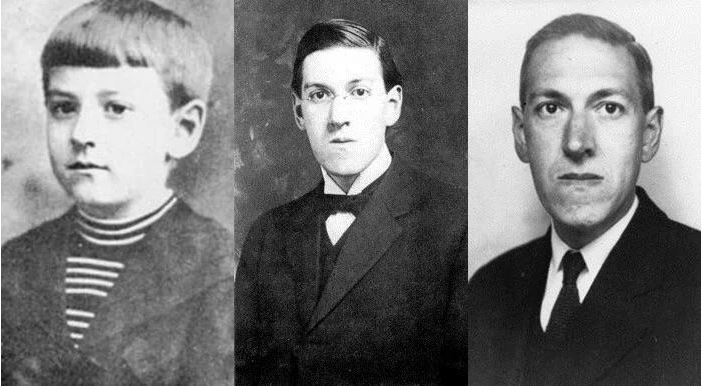
The twentieth century began with the collapse of his grandfather’s financial empire and his death in 1904. Moving from large Victorian rooms to a small rented loft with his mother, Lovecraft, now a teenager, even thought of suicide; only his visceral scientific curiosity for astronomy and chemistry gave him the reason not to. The following years were a succession of isolation, self-taught studies – he never completed high school due to constant nervous breakdowns – and his first steps into amateur journalism, where he began to weave his endless network of epistolary correspondence.
In 1919, the family tragedy repeated itself: his mother Susie, too – prey to visions of monstrous creatures emerging from the dark corners of Providence – was committed to the Butler Hospital, where she died two years later. Five years later, H.P. – who also had recurring nightmares, those very same nightmares he later turned into stories – married Sonia Greene and moved to New York. For the conservative and creature-of-habit “Recluse of Providence”, the chaotic, multicultural, and frantic metropolis was a true trauma. Although he found comfort in a circle of intellectuals and friends, the Kalem Club, his New York experience was marked by economic failure, hunger, and even a burglary that left him with only the clothes on his back. And yet, precisely from this sense of oppression and urban terror, anguish-steeped works saw the light; stories like The Horror at Red Hook and, above all, the draft of that undisputed masterpiece on the insignificance of humanity that is The Call of Cthulhu.
Lovecraft fled New York in 1926 to return to his aunts and his beloved Providence. These were the golden years of his creativity. While living at 10 Barnes Street, and later at 66 Prospect Street, he wrote his most majestic texts, from The Dream-Quest of Unknown Kadath to The Case of Charles Dexter Ward, up to The Shadow over Innsmouth. Far from commercial success – which he rejected almost out of snobbery, withdrawing at an editor’s first refusal – he created the legendary “Lovecraft Circle”: a network of weird fiction writers (including Robert E. Howard, the creator of Conan the Barbarian) who exchanged ideas, monsters, and forbidden tomes, building piece by piece that shared universe we adore today.
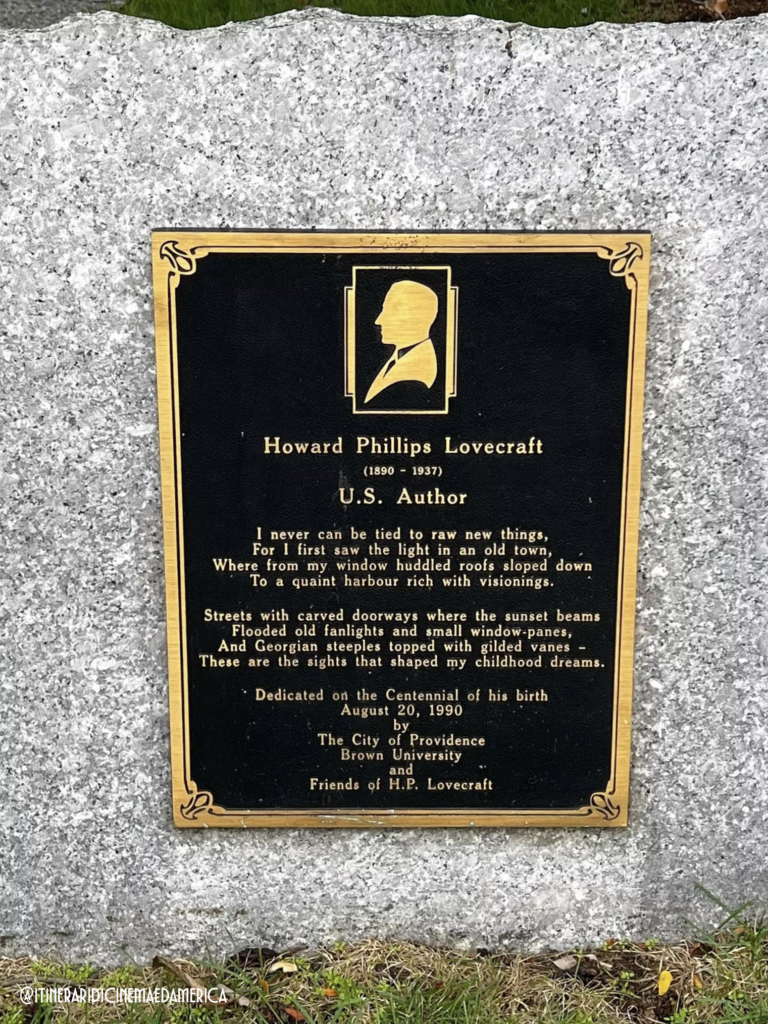
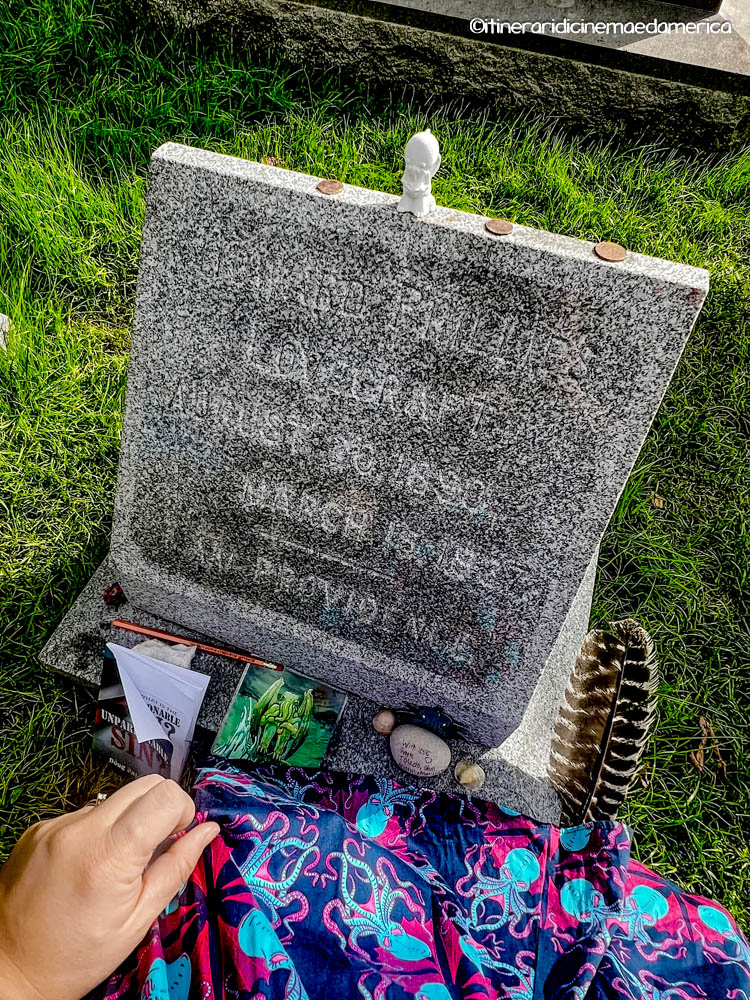
Howard’s end came too soon. The suicide of his brotherly friend Robert E. Howard in 1936 psychologically devastated him. A few months later, he himself was diagnosed with terminal intestinal cancer. He faced the pain with the same stoic and macabre scientific curiosity that animated his characters, keeping a clinical diary of his illness for as long as he had the strength to hold a pen. He passed away on March 15, 1937, at only forty-six years of age. Buried in the Swan Point Cemetery under the Phillips family monument, his name remained in the shadows for a long time. It was only in 1977, thanks to a collection from devoted readers, that the Master finally received a personal, commemorative headstone (but he is not buried underneath it, contrary to what many think; his body remained in the family monument). Engraved in the granite -beneath the dates of birth and death- is a single declaration of eternal love, taken from his own letters, which today welcomes anyone who goes there to pay their respects: “I AM PROVIDENCE”.
Lovecraft’s Literary Legacy: The Cthulhu Mythos
In life, Lovecraft never knew success. He published his stories in penny-a-word pulp magazines, like Weird Tales, and barely survived as a ghostwriter and proofreader. He wrote tens of thousands of letters – estimated at nearly one hundred thousand – weaving a dense network of epistolary exchanges with other writers of the time, encouraging them to use his monsters, his forbidden books – like the famous Necronomicon written by the mad Arab Abdul Alhazred – and his ancient gods to create a shared and boundless mythology.
At the center of this pantheon of horrors is him: Cthulhu, the mammoth entity with a squid head, scaly body, and dragon wings, who lies dormant (but dreaming) in the sunken city of R’lyeh, waiting for “the stars to be right” to awaken and rule the Earth once again.
The cultural impact of this imagery today is incalculable, and much of the credit for preserving and spreading this legacy in a philological and passionate way goes to the H.P. Lovecraft Historical Society (HPLHS). Founded in 1986 by a group of passionate role-players, the association is today a true international institution that transforms his narratives into something more: they record pure 1920s-style radio dramas, print perfect props for investigators (from yellowed telegrams to newspaper clippings), produce parody music albums, and have even shot masterpiece silent-style film adaptations, such as the award-winning The Call of Cthulhu.
To truly perceive how much Lovecraft is venerated, one must go to Providence in even-numbered years, usually on the weekend closest to August 20, the author’s date of birth. This is the period when the city is invaded by NecronomiCon Providence, the largest international festival and symposium dedicated to weird fiction, during which hundreds of academics, directors, role-players, writers, and fans gather in the halls of the Biltmore Hotel and through the city streets amidst literary round tables, the masquerade Eldritch Ball, the Cthulhu prayer breakfast (obviously all fiction!), and film screenings. A festival that transforms Providence into good old Arkham.
The Ultimate Lovecraft Providence Walking Tour
Providence was founded in June 1636 by the Puritan theologian Roger Williams, who had been expelled from the Massachusetts colony due to his overly radical ideas. Williams dreamed of a refuge where church and state were strictly separated, and he purchased this land from the Narragansett Native Americans, renaming it in honor of God’s “Merciful Providence”.
In March 1676, during the bloody King Philip’s War – a conflict between Native Americans and English colonists with their American allies, fought between 1675 and 1678 – the city was razed to the ground and burned by the native tribes themselves. Rising from its ashes, Providence became in the following centuries a flourishing and ruthless commercial port, enriching itself, like many cities of the time, also through the slave trade, only to later reconvert into a thriving textile and jewelry industry. Not everyone knows, however, that the city’s rebellious nature even anticipated the War of Independence: it was here, during the famous “Gaspée Affair” of 1772, that the citizens of Providence set fire to a British customs ship, shedding the very first blood of the American Revolution, well over a year before the famous Boston Tea Party. And it was also Rhode Island that was the first of the Thirteen Colonies to officially renounce obedience to the British Crown in May 1776.
It is among these streets laden with history, revolts, and ancient colonial ghosts that Lovecraft found the inspiration for his stories.
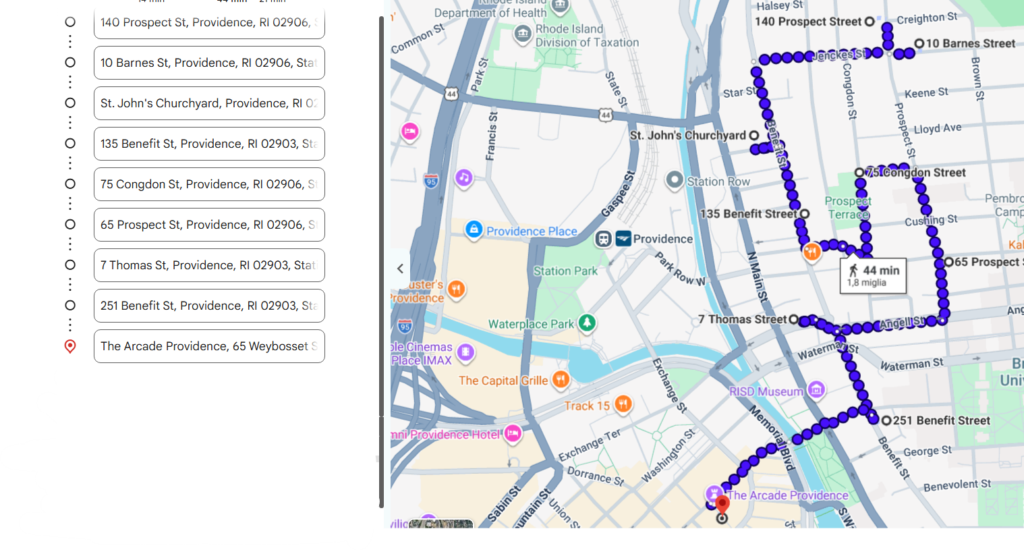
This Lovecraft Providence walking tour, ideal to include in a New England road trip, takes about an hour to complete on foot and is the perfect way to immerse yourself in the Master’s world. Only the Swan Point Cemetery, the final stop, is located a bit further away (about 2 miles from the center) but is easily reachable with a ten-minute drive.
I have divided the route into stops, each connected in some way to the Master’s life, creating a linear and non-“chronological” itinerary, divided into 12 stops. They are all located in the College Hill area, apart from Lovecraft Arts & Sciences, which is in Downtown (or Downcity, as Providence locals call it), and, as already mentioned, Swan Point, on the edge of the East Side.
I make the usual recommendation: many places are private residences, so do not get too close and always respect the privacy of those who live there.
Halsey House (140 Prospect Street):
We begin with the imposing Halsey House, an 1801 villa that in Lovecraft’s time already had the dark reputation of a haunted house. The Master was so captivated by its austere bulk that he chose it as the home for the protagonist of his masterpiece, The Case of Charles Dexter Ward, the novella that more than any other delves into black magic and Providence’s colonial past.
The Master’s Dwellings (10 Barnes Street & 65 Prospect Street)
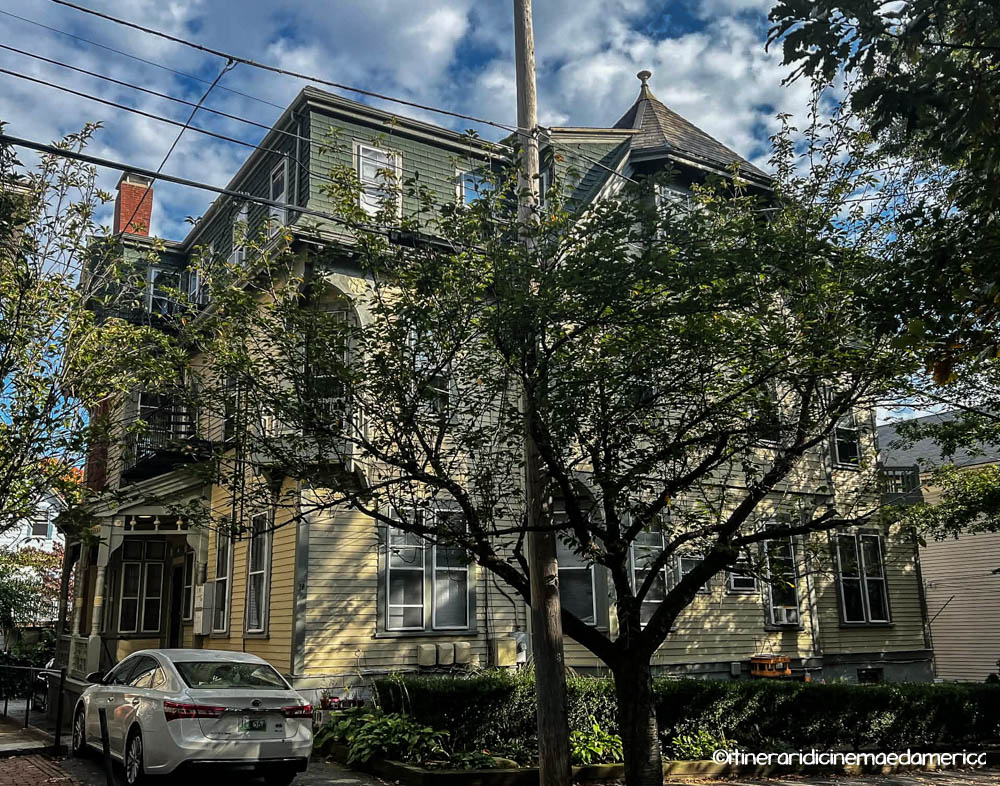
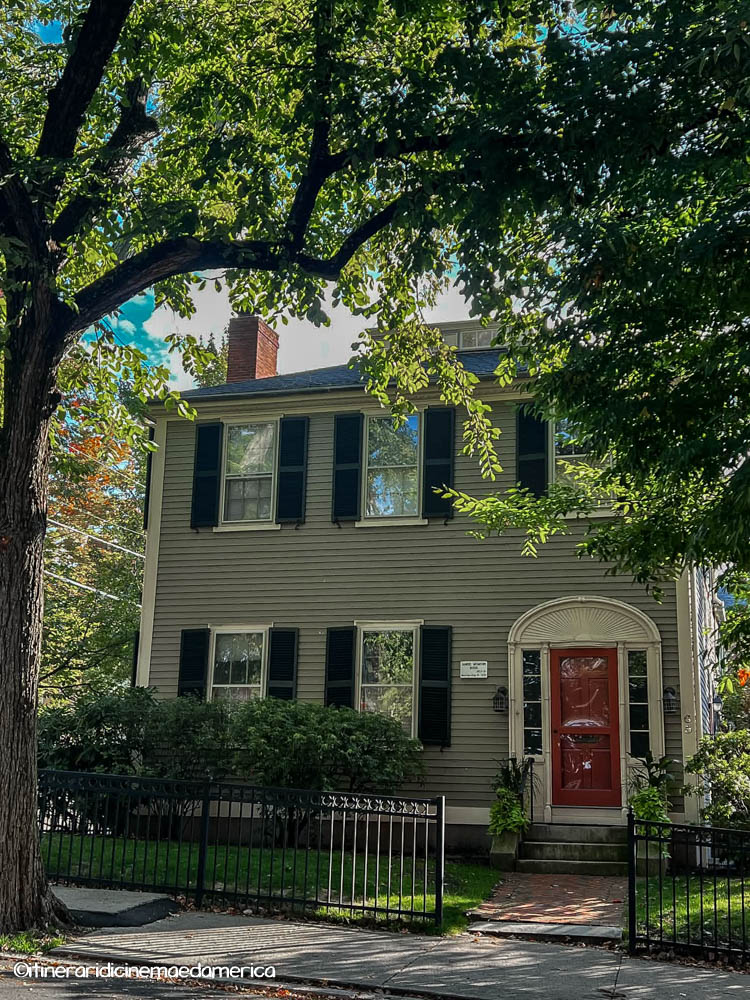
From 1926 to 1933, Lovecraft lived at 10 Barnes Street, the exact address he decided to assign to Dr. Willett, again in The Case of Charles Dexter Ward. Later, he moved to an apartment in the Samuel B. Mumford House at 65 Prospect Street, which became his final residence. In this house, he wrote some of his most famous works, such as At the Mountains of Madness, and used it as the setting for his short story The Haunter of the Dark, where the protagonist Robert Blake sits at the window staring in terror at the outline of Federal Hill, waiting for something to arrive from the darkness.
H.P. Lovecraft Memorial Square (Intersection of Prospect Street and Angell Street)
The must-see spot on College Hill for all true devotees of the Master is located at the northwest corner of Prospect and Angell Street, right where Lovecraft’s birthplace once stood (at number 454, unfortunately torn down decades ago): H.P. Lovecraft Memorial Square. In 2013, the city installed a commemorative plaque to officially consecrate this intersection, at the spot where the architect of nightmares took his very first steps.
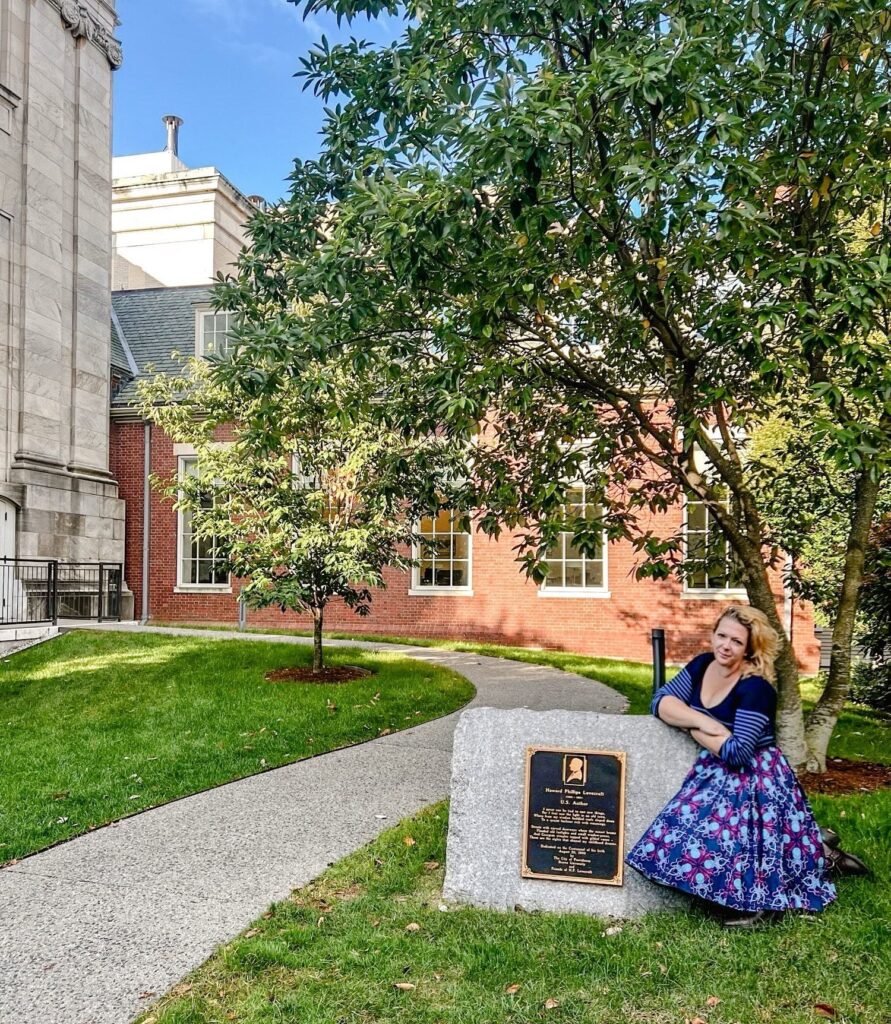
H.P. Lovecraft Memorial (John Hay Library, Brown University – 20 Prospect Street)
Not far away, nestled in the prestigious campus of Brown University – an academic institution that Lovecraft cited very often to give authority to his scholars in the stories – lies a literary tribute to the Recluse of Providence. In 1990, on the occasion of the centenary of his birth, the H.P. Lovecraft Memorial was erected, a tribute born thanks to the dedication and joint efforts of his greatest biographer S.T. Joshi, Will Murray, Jon Cooke, and the “Friends of H.P. Lovecraft” association. The place to put it was not chosen by chance: behind the plaque stands the magnificent John Hay Library, which houses the largest and most precious collection in the world of the author’s original manuscripts, notes, and letters. A true sanctum sanctorum for anyone who wants to delve deeper into the life and works of the creator of Cthulhu.
The Cemetery of St. John’s Cathedral (271 North Main Street)
This Episcopal cathedral houses an ancient graveyard, dating back to 1720. It was one of Lovecraft’s personal pilgrimage sites, as he loved strolling among these wind-eroded tombstones, exactly as Edgar Allan Poe had done decades before him.
Stephen Harris House (135 Benefit Street)
Built in 1764, this dwelling with a sinister and decaying charm is the absolute protagonist of the short story The Shunned House (1924). Lovecraft knew the building well because his aunt Lillian lived there between 1919 and 1920. In the story, the cellar of the house hides a vampiric monstrosity that feeds on the life energy of the tenants. Today the house is white, bright, and luminous, and it’s hard to imagine it hiding frightening secrets… but who knows?
Prospect Terrace (75 Congdon Street)
To understand the bond of love between Lovecraft and his city, you have to sit on the benches of this small sloping park. It was one of the Master’s favorite refuges. From here you dominate the entire skyline of Providence: at sunset, when the sky catches fire and the pointed roofs become black silhouettes, it truly feels like looking at the city through Lovecraft’s eyes. Since 1939, an imposing statue dedicated to the founder Roger Williams, also stands here… if you imagine it in the evening, enveloped in a light mist, it is that extra touch that helps you slip into Lovecraftian atmospheres.
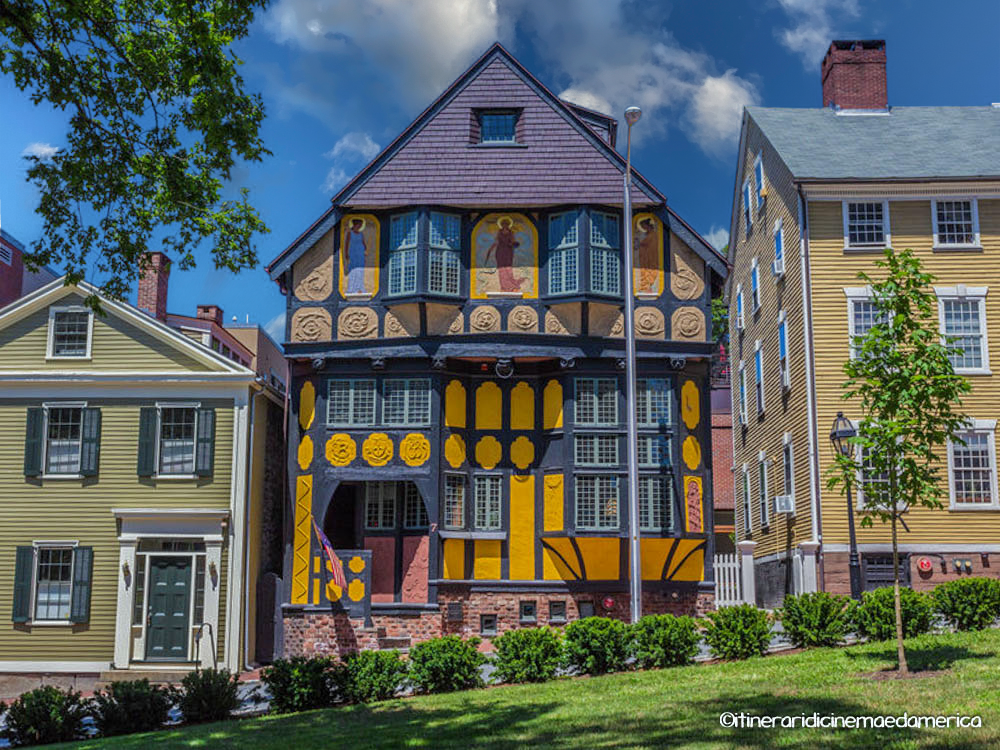
Fleur-de-Lys Studio (7 Thomas Street)
A short detour to this bizarre and wonderful house built in 1885 by the artist Sydney Richmond Burleigh is a must. The facade is decorated with strange high reliefs, and the bright colors are a strange contrast to the dark imagery of the Mythos that has accompanied us so far. Does the name sound familiar? That is because it is almost a sacred icon for fans: in the short story The Call of Cthulhu, Lovecraft decides that this is the home of the eccentric and tormented sculptor Henry Anthony Wilcox, the young man who models the monstrous idol of Cthulhu in his dreamlike deliriums.
Providence Athenaeum (251 Benefit Street)
Heading up the beautiful and aristocratic Benefit Street, we come across the Athenaeum, a 1836 library that recalls the style of Greek temples. Lovecraft, who lived just a block away, was a regular visitor to these halls filled with ancient tomes, and loved to lose himself among the shelves.
The building is also fundamental for another romantic and macabre reason: it was precisely within these walls that Edgar Allan Poe courted the poet Sarah Helen Whitman. Because of this, you can find busts of both writers inside. And let me reveal a gem: Lovecraft’s bust was donated to the Athenaeum in 2013, right during the days of NecronomiCon, by the sculptor Bryan Moore. If you approach the pedestal to read the commemorative plaque, you will discover that the work was made possible by a fundraiser, and among the names of the main donors stands out that of Guillermo del Toro, along with the great Lovecraftian biographer S.T. Joshi.
Weird Providence – Lovecraft Arts & Sciences (65 Weybosset Street)
For the penultimate, and beautiful, stop on the itinerary, you leave College Hill to reach historic downtown, inside the gorgeous The Arcade gallery. Here you will find Lovecraft Arts & Sciences (also known as Weird Providence), the nerve center of the worldwide fandom, the headquarters of NecronomiCon, and a true sanctuary full of rare editions, academic essays, gadgets, and detailed maps to explore the Lovecraftian universe. I could have spent hours in there!
Swan Point Cemetery
The final stop of our Lovecraft Providence walking tour is located just outside the center, in the vastness of the Swan Point Cemetery.
After a life of hardship and tormented dreams, Lovecraft found rest here in 1937, in the family tomb. For decades, his name appeared only on the central family obelisk, but in 1977 a group of passionate fans took up a collection to give him a personal headstone. Engraved in the granite, you can read a single, simple phrase taken from his own letters: “I am Providence”.
On the headstone, it is customary to leave coins, pens, or small plush octopuses as a sign of gratitude. A necessary stop and greeting to the Master who invented not only modern horror but a true expanded universe that, a century later, continues to dominate our reading, Hollywood films, and our imagination.
Films Shot in Providence
Strolling through Providence, you might get a feeling of déjà-vu: thanks to its colonial architecture and New England atmosphere, Providence has been chosen dozens of times as a set by Hollywood.
It is right here, on the downtown streets, that the Farrelly brothers set the politically incorrect comedy: There’s Something About Mary (1998), starring Cameron Diaz and Ben Stiller. Also set in the city were the touching Dan in Real Life (2007) with Steve Carell, and the flying dog fairy tale Underdog (2007). The historic architecture also served as a backdrop for Steven Spielberg’s historical epic Amistad (1997).
Finally, more recently, Providence hosted the great and highly anticipated return of the Sanderson sisters: much of the filming for Hocus Pocus 2 (2022) was shot right here, taking advantage of the city’s spooky autumnal atmosphere to recreate the dark yet fun magic of Salem.
The Masters Who Inspired Lovecraft and His Heirs
Lovecraft did not create his universe out of nowhere. In his letters, he always paid a huge debt of gratitude to the writers who inspired him. First and foremost, of course, Edgar Allan Poe, whom he adored and of whom he considered himself the direct narrative successor. To understand the architecture of his gods and his sense of the fantastic, however, we must mention the dreamlike atmospheres of the Irishman Lord Dunsany, the visceral terror of nature of the Scotsman Arthur Machen, and the ghostly urban visions of Robert W. Chambers, the brilliant creator of the King in Yellow, a figure that would later forcefully enter the Lovecraftian mythos, becoming one of its symbols.
Who, on the other hand, has picked up the baton of the Master of Providence today, bringing his unspeakable horrors to the big screen?
The list of Cthulhu devotees is very long and boasts the biggest names in cinema. There is John Carpenter, who, with The Thing (the isolation, the amorphous shapeshifting monster) and In the Mouth of Madness (an homage right from the title), translated the pure sense of cosmic helplessness onto film. There is Guillermo del Toro, a true fanatic of the author, who tried for years to bring At the Mountains of Madness to the cinema and who has paid homage to Lovecraft visually and narratively in works like The Shape of Water or the anthology series Cabinet of Curiosities (which hosted two direct adaptations of the writer). There is the intense and splatter flair of Stuart Gordon, who in the Eighties transformed the Master’s prose into absolute cult classics like Re-Animator and From Beyond. There is Ridley Scott, who with his Alien effectively created the perfect “Lovecraft in space”: a black cosmos, a spaceship abandoned for eons, unknown space engineers, and a lethal biomechanical creature. And finally, the tireless Sam Raimi, who in the Evil Dead saga made the infamous Necronomicon Ex-Mortis the most famous cursed book in pop culture history, uniting terror, demons, and chainsaws all in one go.
Providence is all of this: a crossroads where American colonial history, the despair of a misunderstood genius, contemporary cinema, and the fascination with the unknown blend indissolubly together.